Glückauf!
black-tech.de
black-tech.de
| DE | EN |
The Six-Axle
DÜWAG Articulated Tram
with special focus on the Essen GT6-ZR
Modernisation during the Economic Boom
Once most wartime damage had been repaired, many tram operators in the Ruhr region began modernising their ageing fleets during the economic boom years. In 1951, the first large-capacity single-ended tramcars were delivered to the Essener Verkehrs-AG (EVAG) and the Duisburger Verkehrsgesellschaft (DVG): marking the beginning of a new era.These four-axle large-capacity cars, built by DÜWAG, were later also acquired by the Vestische Straßenbahnen and the Hagener Straßenbahn in a bi-directional version.
At the time, the economy was flourishing: mines and steelworks were operating at full capacity, and most people relied on public transport to reach their workplaces. Cars were not yet a competitor. It soon became clear that the existing tramcars offered too little capacity for the main lines. They were often operated with two- or four-axle trailers, which required a second conductor.
Development of the Six-Axle Articulated Tram
To increase capacity while reducing staffing requirements, DÜWAG began developing six-axle single-ended articulated trams in 1955. In 1956, the BOGESTRA became the first operator in the Ruhr region to receive this new vehicle type.However, the single-ended version was unsuitable for Bochum:
- only a few termini had turning loops
- some interurban routes had platforms on only one side
The First GT6-ZR (from 1957)
The first vehicles were delivered in 1957. They resembled the familiar large-capacity cars in appearance and the articulated cars in construction, but differed in their door arrangement: 1-2-1-2.Key specifications:
- width: 2.20 m
- length: 20.1 m
- capacity: up to 180 passengers, including 44 seats
Because point setting was controlled via overhead wire contacts, the pantograph was mounted near the articulation to improve visibility for the driver. In 1963, car 272 received a trial single-arm pantograph, which was later removed.
Operation and Liveries
With the exception of the lines to Stiepel (5, 15) and the routes between Wanne and Steele (4, 14), the GT6-ZR operated on almost all remaining lines. Car 262 underwent test runs in Wuppertal and Saarbrücken in 1957, though no orders followed.Between 1957 and 1969, a total of 91 cars were delivered (numbers 261 - 298 and 1 - 53).
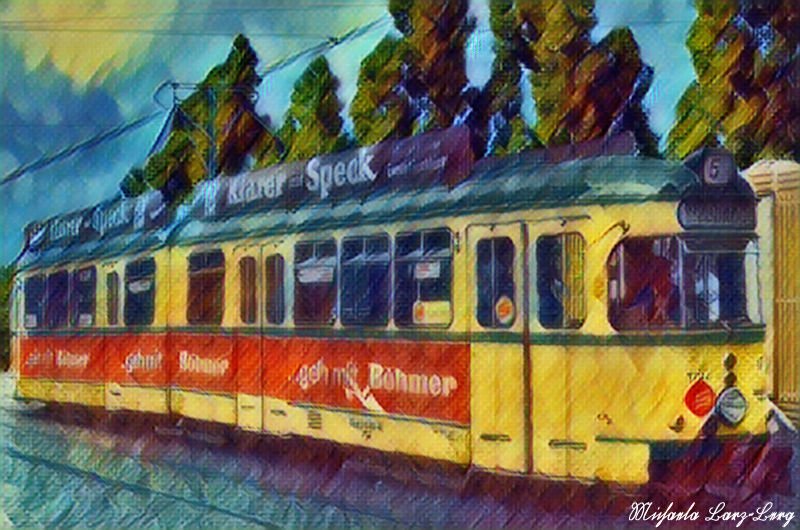
Original livery:
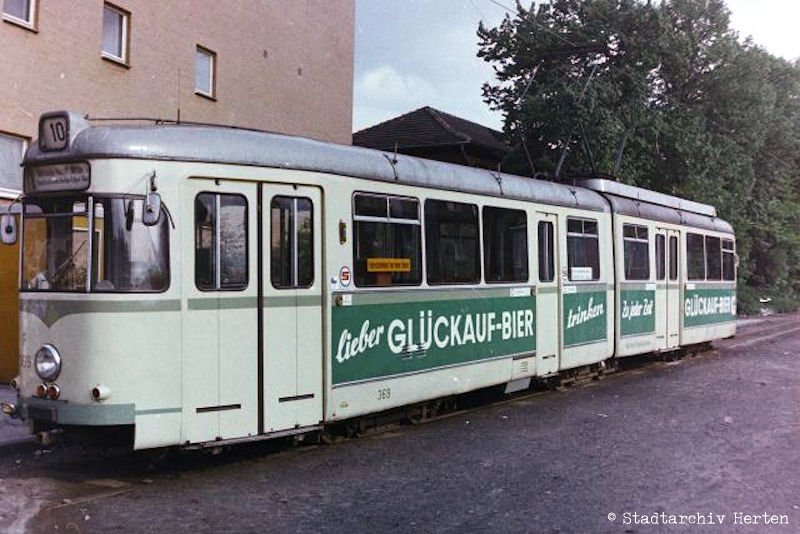
- green-beige base colour
- decorative stripes in grass green and bottle green
- machine-grey roof
In the 1990s, some tunnel-capable cars received the new VRR "City-Express" livery. The Bochum-based vehicles retained their green-beige livery until withdrawal.

Sales Abroad and Final Years
Due to the delivery of the M-cars and route closures, several GT6-ZR became surplus in the 1980s and were sold:- from 1985: 8 cars to Lille (France)
- 1994: 9 cars to Ghent (Belgium)
- 1994/95: 6 cars to Gotha (Thuringia)
- 2002: 1 car to Innsbruck (Austria)
- 1998/2000: 8 cars to Arad (Romania)
After the withdrawal of the last cream-coloured cars in the mid-1990s, the tunnel-capable vehicles operated on lines 306 and 310. The final cars were TW 40 and TW 50 (renumbered 640 and 650), which had already been transferred to the works fleet but continued to run occasionally due to vehicle shortages.
The GT6-ZR in Essen
Procurement and Distinctive Features
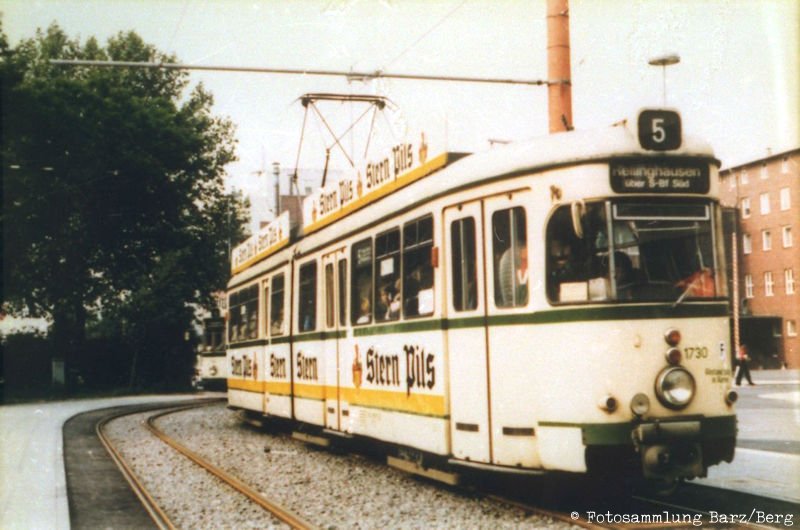
In my hometown Essen, the EVAG purchased ten bi-directional articulated trams in 1962/63, after already having more than 60 single-ended six-axle cars. The reason was the lack of a turning loop at the terminus of line 36 at Pferdemarkt in Bottrop.The Essen cars differed by having a double folding door at the front, resulting in the door arrangement 2-2-1-2.
Numbers and build years:
- 1721 - 1724 (1962)
- 1725 - 1730 (1963)
- cream
- green decorative stripes
- green roof (later repainted cream)
Service on Essen Lines
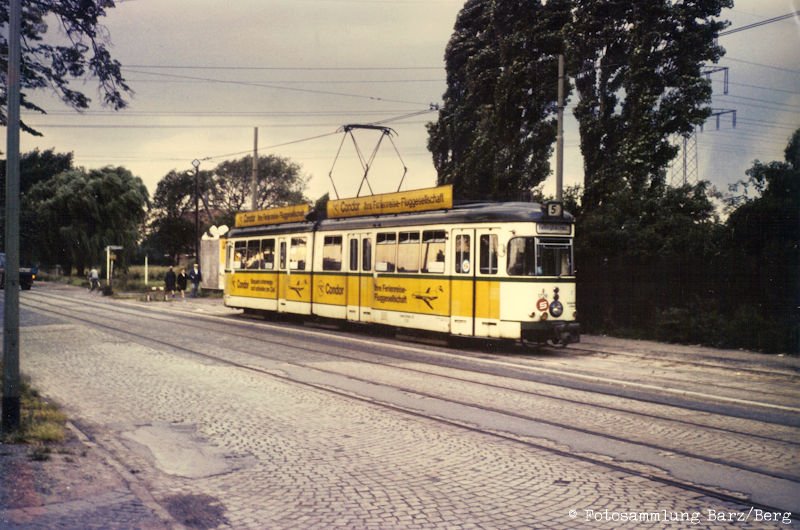
Initially, the GT6-ZR operated on lines 26 and 36. After the closure of the Bottrop route in 1967, they moved to line 5, whose new terminus in Frintrop was a stub end: ideal for bi-directional trams.For more than 20 years, the "1700 series" shaped the appearance of line 5/105, until they were replaced by M-cars in the early 1990s.
Conversion to Eight-Axle Cars
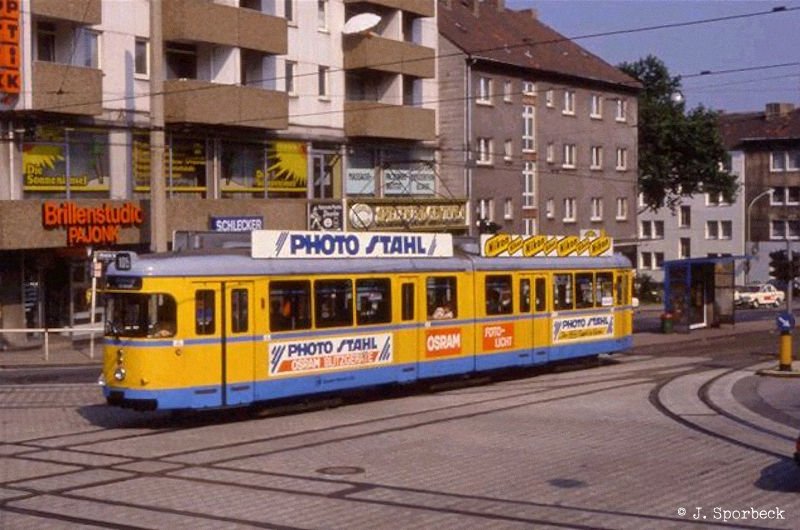
Due to rising passenger numbers, EVAG decided to lengthen the cars by adding centre sections, converting them into eight-axle trams.- TW 1721, 1723, 1727 and 1730 received centre sections from withdrawn Duisburg single-ended cars
- the remaining cars received centre sections from withdrawn Essen vehicles
They operated on all lines without high platforms, mainly 103, 104, 106 and 115.
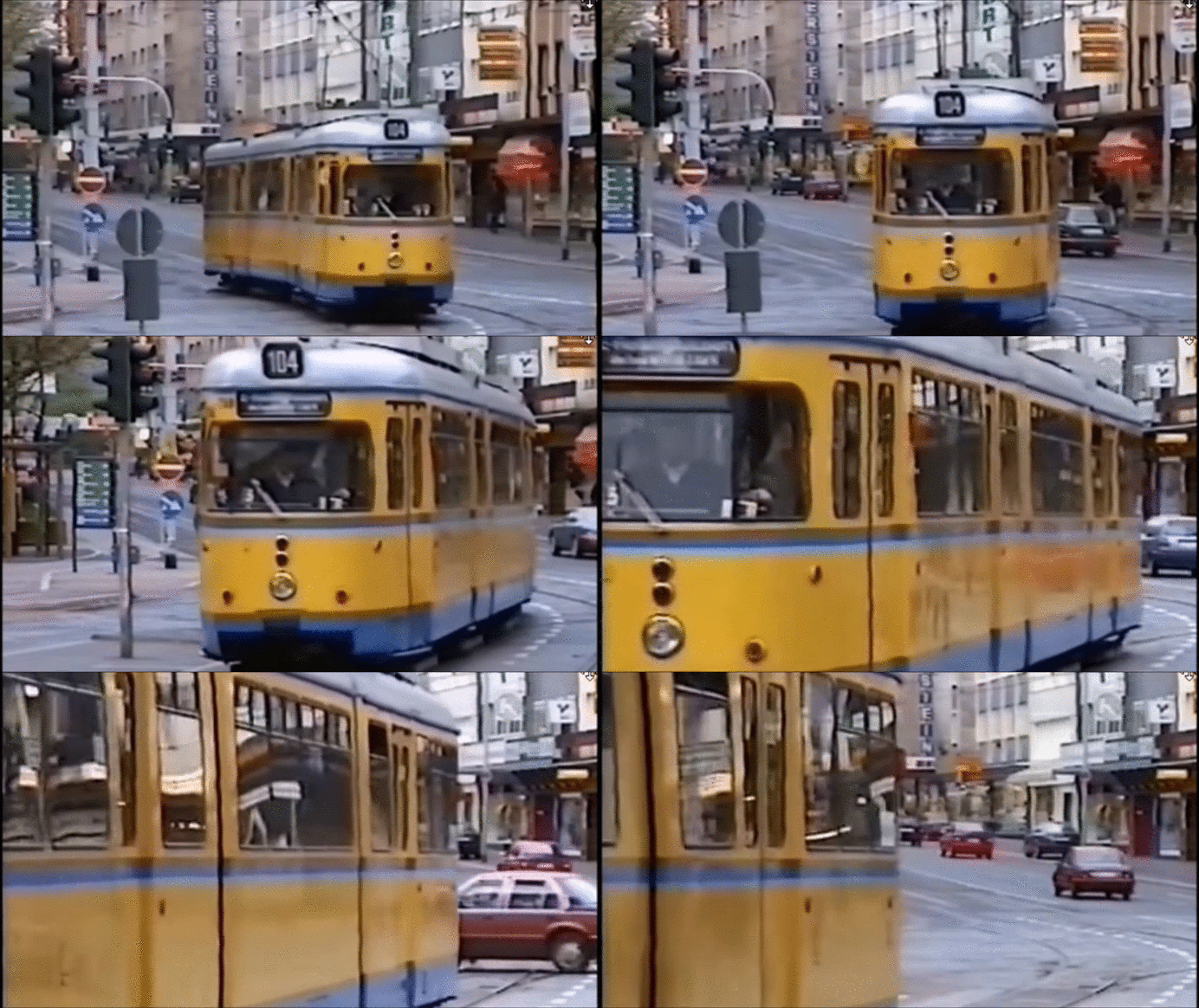
| TW 1758 auf der Linie 104. |
Withdrawal and Preservation
With the regauging of the Altenessen-Karnap-Horst route in 1998, many metre-gauge trams became surplus. The "1700 series" was withdrawn and sent to Arad (Romania).Cars 1755, 1758, 1759 and 1760 were used only as parts donors and later scrapped, the last being TW 1755 in 2009.
Only one car survives today:
TW 1753 - preserved as a historic tram in Essen.
References:
- verschiedene Ausgaben des Magazines "Sternfahrt"
© Michaela Barz-Berg
Return to website "steam locomotives and trams in the Ruhr area"
⚒ Glückauf! ⚒
Michaela Barz-Berg, 05.2002 - 2026